route setting
Welcome to our route setting* page! This page offers a comprehensive outlook on our gym’s setting system, including our grades and acsent rules, our bouldering wall map, our setting schedule, notes about select climbs, and setting team roster.
*route setting is the process of creating indoor climbs. A team of skilled and enthusiastic route setters / climbers craft new climbs on a regular basis.

-
Sep 30 Wave Wall
Oct 7 Shallow Slabs
Oct 14 Cape Smear
Partial Reset. Remaining climbs will be backfilled for Mock Comp on the following Sunday.
Oct 21 Middle Rock
Nov 4 Deep Cove
-
Joel Harvie (Head Setter)
Daniel Alacoque (Assistant Head-Setter)
Julia Bruce-Robertson (Assistant Head-Setter)
Hannah Adams
Keely Whitelaw
Mitchell Clowe
Xenia Healey
Emmett Booth
Grades & Ascent Rules
Our Grading System
Grades are a tool to help navigate our collection of climbs by identifying a climb’s approximate difficulty level.
The Cove has its own grading system which consists of 6 levels, as seen in the following graphic.
Difficulty in climbing is highly subjective, so it is common for grading to feel inaccurate. If something feels easier or harder to you, your experience is more valid than the assigned grade!

how are grades assigned?
Difficulty ratings are assigned by our experienced setting staff. Our setters consider the R.I.C. scale (Risk, Intensity, Complexity) when determining difficulty.

ascent rules
-
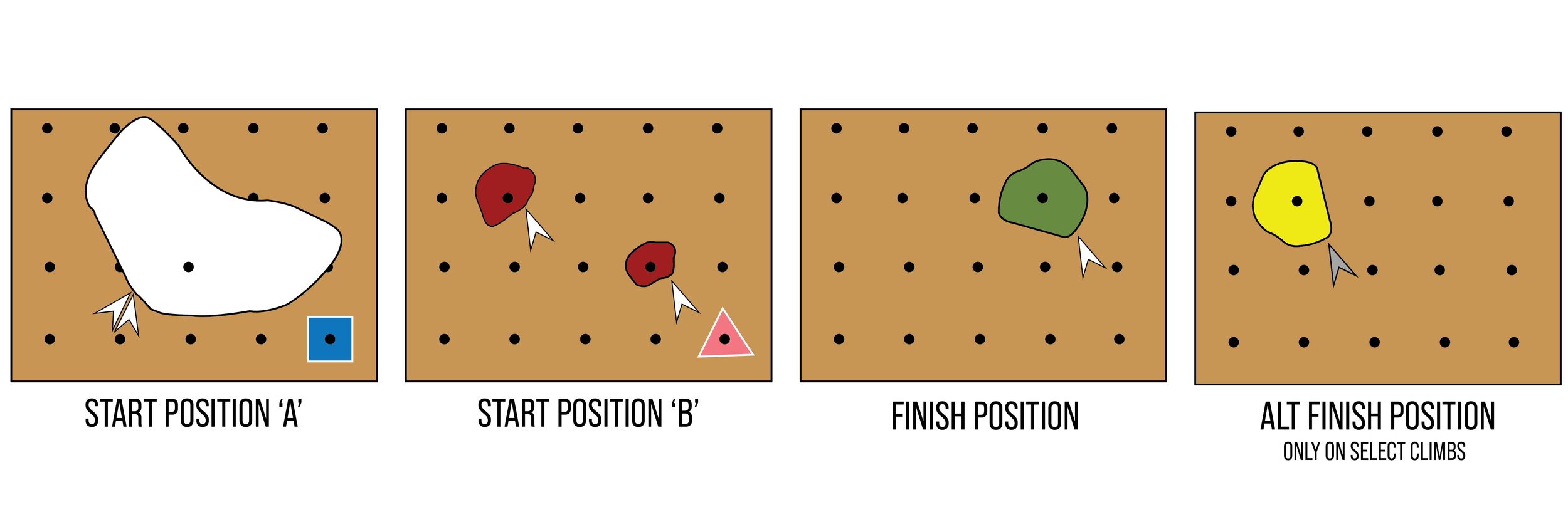
The grade tag for any given climb will be positioned next to the start hold(s).
-
Two white arrow tags will identify where a climber must start. Both tags will be either on the same hold or on two different holds.
To secure the start position, climbers must use hands on the tagged hold(s) - one hand on each hold if two are tagged.
Climbers are permitted to jump from the ground, kick off the wall, or simply pull into the start position, but the first place the climber’s hands are allowed to be is on the start holds.
Before moving on, the climber must hold the start position in control*.
*Control is being stable without any movement/momentum, or by holding the start hold(s) for 3 full seconds.
-
To finish the climb, the climber must maintain control* of the tagged hold at the end of the climb with both hands.
On our tall wall (Deep Cove in Boulder Bay), lower alternative finishes are tagged with grey tags on climbs graded blue square and below. These are required finishes for climbers aged 8 and under, but are also for anyone not wishing to climb to the full height.
*Control is being stable without any movement/momentum, or by holding the finish hold for 3 full seconds. -
White tape is now used to create alternate versions of select moves.
If white tape is connecting multiple holds together: Use only 1 hold in the series connected by tape.
If a single hold is marked with white tape : Choose whether or not to use the marked hold. These holds are commonly used to make accessible versions of the climbs for shorter climbers.
By creating bigger, smaller, or simply different versions of the same sequence, we offer more general movement variety AND we offer similar moves to climbers of different sizes.
-
At the Cove, Grey holds are used as down climb jugs and coaching holds. They do not belong to standardly set climbs.
-
What is in? (can be used)
Volumes
Bolt holes in holds
What is out? (can’t be used)
Bolt holes in the wall and in volumes
Edges of volumes are the meet the wall
All 3 plexiglass walls
Top edge of all walls
The left-most edge of the climbing terrain in Boulder Bay (main room)
The side-walls in The Narrows (back room)